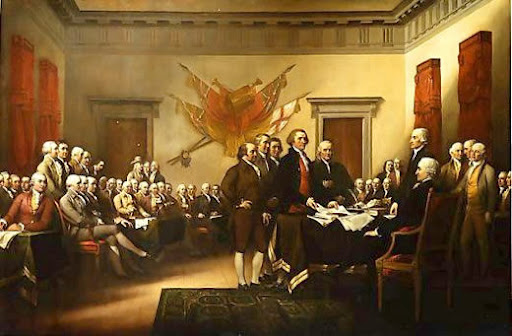
The year is 1776, the warm July sun is shining on the roof of Independence Hall in Philadelphia, Pennsylvania. Inside, 56 delegates representing 13 American colonies are signing one of the most important documents in human history: the Declaration of Independence. This document was the birth certificate of the USA and presented a clear Biblical framework for our freedom.
Ever since that day, 250 years later, this document has held America fast to liberty, biblical principles, and morality written for her future. The United States has never ceased to flourish since the day she was founded and continues to have an amazing history and legacy. The morals and laws upheld in its founding documents are quite astonishing.
How did America get to be in such a position that the patriotic spirit of freedom fills the air and the “American Dream,” desired in many citizens hearts spreads light to the rest of the world for all to see? It all goes back to its founders… since the pilgrims came to our shores in 1620, religious freedom has always rung true and has been the single most important principle of early American life, this was at the heart of it all. Only when religion was free could it be true religion, and only then could all other freedoms follow. This religion was ultimately a faith in God and a trust in His Holy Word. Psalm 127:1 says: “Unless the LORD builds the house, they labor in vain who build it; unless the LORD guards the city, the watchman stays awake in vain.” (NKJV)
Many signers behind the Declaration like Samuel Adams, John Witherspoon, and others professed faith in Christ, and undoubtedly understood the concept and framework for a blessed and flourishing country. When the nation follows the standard of law that follows the essence and truth of God’s character and nature, the nation flourishes. Alexis De Tocqueville, a French diplomat, political philosopher, and historian who traveled to America once wrote: “In France, I had almost always seen the spirit of religion and the spirit of freedom marching in opposite directions. But in America, I found that they were intimately united and that they reigned in common over the same country.”[i]
The first patriots who came to our shores were in their writings and practice looking for freedom and religious liberty. They knew that they were to be a “city on a hill.” If they passed this view onto their children and grandchildren, the future of America would hold true to the biblical values and thus would bring blessing.
During the early years, education in America was thoroughly Christian. The schooling in the Colonies was taught mainly by the family and church and had a biblical basis. When school children learned their ABC’s, they also were taught Bible truths. An early schoolbook called the New England Primer, an approximately 90-page book full of moral lessons and teaching, was used for the average schoolchild. One of its alphabet lessons for youth says:
“A wise son maketh a glad father, but a foolish son is the heaviness of his mother.
B etter is a little with the fear of the Lord, than great treasure and trouble therewith.
C ome unto Christ all ye that labor and are heavy laden and He will give you rest…”[ii]
These were the things that early Americans was taught, and this type of schooling reflected further on what type of decisions were made when these citizens faced challenges. Proverbs 9:10 speaks to this, “The fear of the LORD is the beginning of wisdom, and the knowledge of the Holy is understanding.” (NKJV)
We also see that all the early colleges like Harvard, Yale, Cambridge, and Princeton were made solely for the purpose of raising up biblical leaders and missionaries. One of the rules and statues for students at Harvard college 1643 was this: “Let every student be plainly instructed and earnestly pressed to consider well the main end of his life and studies is to know God and Jesus Christ which is eternal life.” (John 17:3).[iii]
The regulations here for students at Harvard were Biblically based and were designed to make responsible people. Harvard University has greatly impacted the history of the United States for good. Many early American presidents were trained at this school including John Adams, John Quincy Adams, Rutherford B. Hayes, Theodore Roosevelt, Franklin D. Roosevelt, John F. Kennedy, and George W. Bush.[iv] Students who graduated from this school not only were leaders, pastors, and missionaries, but also were able to serve their communities in other areas, and did all, as they were taught, for the glory of God.
A review of biographies of the founders shows that approximately forty percent of the signers of the Declaration of Independence were educated in schools that focused on training for ministry.[v] Men such as Thomas Jefferson, Benjamin Franklin and others were regular readers of the Bible and attended church services. George Washington, our first president, who attended the signing of the Constitution, another founding document, was in his writings and character a religious man and had strong Christian convictions influenced by faith and trust in the Almighty God.
There are numerous other men who influenced the course of history by their faith and preaching, like George Whitefield and Johnathan Edwards. These men sparked spiritual revival and placed more passion in the hearts of the people which set off long-lasting results.
I bring this all up to say that faith and trust in the Lord will ultimately bring blessing and many of the men of our founding fathers were all influenced by God’s Word and by moral principles. This is what has affected the founding of our nation.
Another topic that has to be addressed is assessing the failures of America. If she has committed so many wrongs, done so many terrible things, and made many mistakes even though she started out with faith in God, how can we trust her or even have any pride in our country? Ronald Reagan, America’s 40th president pointed out: “If we forget what we did, we won’t know who we are.”[vi] Loving and appreciating who we are means that we must know the good and the bad of what we have done. In many ways, seeing the bad things about ourselves can be a big development in the right direction. Matthew 22:39 says, “You shall love your neighbor as yourself” (NKJV). Here, Jesus is talking about the greatest commandments in the law. When He says to love our neighbor as ourselves, it assumes that we already love ourselves. If we don’t love ourselves and take pride in what is ours, then how can we be in a position to love others? Eric Metaxas explains this in his book, If You Can Keep It:
“If I hate myself, how can I extend anything worthy to someone in another country? If I want to give money to others, don’t I first have to possess it myself? Isn’t hating one’s country in fact, kind of a reverse pride, one that puts too much focus on ourselves at the expense of a more balanced and gracious view, the kind that we are to have toward others? If God calls us to love our enemies, can’t we apply that to ourselves as well, to treat ourselves with love, despite knowing the worst of our sins?”[vii]
In summary, America has been blessed because of the faith on which she was built upon. The founding fathers of the United States and signers of our founding documents were raised with the biblical worldview and the understanding that what holds us together must be built on truth.
Myself, as a sixteen-year-old young man growing as a Christ-built warrior-poet will press on in this present age, as Romans 5:2b-3 says: “…Knowing that tribulation produces perseverance; and perseverance, character; and character, hope” (NKJV). And I will, in the future, elect those in authority, and pray for our officials. 1 Timothy 2:1-2 points out: “Therefore I exhort first of all that supplications, prayers, intercessions, and giving of thanks be made for all men, for kings and all that are in authority, that we may lead a quiet and peaceable life in all godliness and reverence” (NKJV).
I will learn and grow in all areas so that, as the early Puritans believed, whatever field God calls a Christian to pursue, he should pursue it vigorously for the glory of God. And I will instill wisdom, vision, and courage, the truths of Scripture and the truths of history into the hearts of my children and the next generation so that, in turn, they can carry on for the glory of God.
As I reflect on all of what has made America great, we must keep the republic, as Benjamin Franklin put it and keep honoring God as Americans like our pledge reminds us…“I pledge allegiance to the flag of the United States of America, and to the REPUBLIC for which it stands, one nation, UNDER GOD, indivisible, with liberty and justice for all.”
*Submitted to the James Dobson Family Institute for their America 250 Essay Contest.
[i] Eric Metaxas, If You Can Keep It: The Forgotten Promise of American Liberty. (New York, NY: Penguin Books, 2016), 63.
[ii] New England Primer. (San Antonio, TX: Vision Forum, 2010), 20.
[iii] David Gibbs, One Nation Under God: Ten Things Every Christian Should Know About the Founding of America. (Christian Law Association, 2013), 147.
[iv] IBID, 150.
[v] IBID, 139.
[vi] Eric Metaxas, If You Can Keep It: The Forgotten Promise of American Liberty. (New York, NY: Penguin Books, 2016), 225.
[vii] IBID, 229.
